The Montana state bird is like the state’s citizens: deeply protective of its territory, fans of fence posts to mark land, and solitary–no wonder the Western Meadowlark was chosen as the state bird.
But unlike the Montana State Flower or Animal, which were chosen by adult voters, Montana’s children picked this songbird to represent their state.
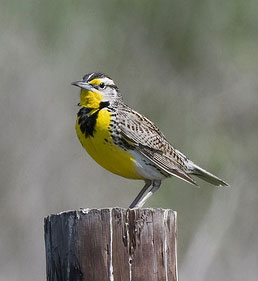
The Western Meadowlark’s habitat consists of expansive grasslands such as plains, prairies and meadows. It can often be spotted on fence posts in Montana’s western agricultural areas.
Compared to other birds, the western meadowlark’s migration is short, but broad enough to represent Wyoming, Kansas, Nebraska, North Dakota and Oregon as their state bird, in addition to being the Montana state bird.
Identifying Montana’s State Bird
 |
|
The Montana State Bird |
The Western Meadowlark is a distinct bird, but can easily be mistaken for the Eastern Meadowlark.
Their voices are the distinguishing factor, as the Western Meadowlark’s song is a seven to ten note melody, concluding with three falling notes. The Eastern Meadowlark’s song is much more basic.
Other identifying characteristics are:
- A sharp, brown bill
- Brown wings with black markings
- Brown tail with white, hind feathers
- Brown legs and feet
- Yellow belly with a black “V” on its chest
- Yellow throat
- White flanks with black markings
- 8.5 inches in length
Western Meadowlark Behavior
Male Meadowlarks typically migrate to the breeding grounds about a month before the female. It tends to perch on human constructions such as poles and fences while singing its song to mark territory and wait for the arriving female.
When it finds a partner, the two meadowlarks build a nest composed of pine needles, grass and horsehair. Female Western Meadowlarks lay anywhere from three to seven eggs. After a two-week incubation period, the hatchlings emerge and are tended to for approximately 12 days before leaving the nest.
Western Meadowlark Diet
The Western Meadowlarks diet consists primarily of small insects, such as:
 |
|
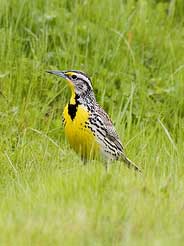
The Western Meadowlark |
- spiders
- grasshoppers
- caterpillars
- and snails
- as well as small seeds and berries.
It primarily forages on the earth’s surface and beneath the soil.
In order to evade predators such as owls, coyotes, cats and dogs, the Western Meadowlark seeks its food under the cover of low-lying vegetation.
More Montana Fish & Wildlife Information
Montana Fish & Wildlife – Return back to information on Montana Fish and Wildlife
Or go home from learning about the Montana State Bird to the Glacier National Park Travel Guide





I love this help