Philip Anschutz is drilling on the Blackfeet Indian Reservation outside of Glacier National Park. Tony Bynum is documenting it. Read our interview with him
Tony Bynum is a Glacier National Park photographer. He has been documenting Glacier National Park and the Rocky Mountain Front landscape for decades. Now, he is taking his talents to documenting the oil drilling on the Blackfeet Indian Reservation.
Blackfeet Reservation Oil Drilling
You can learn more about his project & the oil drilling along the Rocky Mountain Front & Blackfeet Indian Reservation here.
Here is our interview with him.
1. What is your experiencing photographing Glacier National Park and the surrounding area?
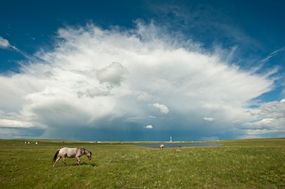 |
I’ve been exploring and photographing Glacier National Park and the surrounding rocky mountain front and Blackfeet Reservation area for a little more than a decade. I know the little nooks and crannies and how and when to be there.
But knowing it, really knowing a place is to understand that it’s always different and always changing. As a trained geographer I can’t sit still. I always need to learn more about places, particularly one’s where i choose to live.
That said, even with my constant pursuit of knowledge about the place, both from the air, and land, I always see and learn new things. I’m often asked ‘do you want to go other places around the world?”
My answer is always, “Sure, but it’s not a priority as I have yet wear-out the the rocky mountains – there’s still a lot of exploring to do right in my own North American back yard.”
2. Why photograph the Blackfeet Indian Reservation and the oil drilling now? What about this specific project inspired you to begin?
 |
Because it’s real, it’s right, and it’s relevant.
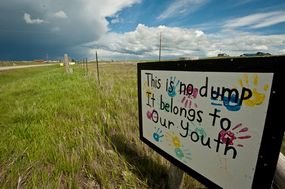
The change is now, it’s not tomorrow, there is no tomorrow when it comes to documenting a changing landscape on the scale we are seeing today with the Blackfeet Indian Reservation Oil Drilling.
The forecast is for 50 more wells in the next year or so, with up to 500 or more on the way if they –strike-it.
There are already more than 20 (interactive map of oil drilling on the Blackfeet Indian Reservation) and there are permits for 70 – you do the math.
While we can’t predict the future (at least I can’t) we can surmise, based on history, that oil drilling has always changed people and land. So, one has to capture the activity – the drilling and (building of) roads- when it occurs. Too many projects start too late, after it’s “over” and the change has occurred.
I wanted to move into this project being able to anticipate change but knowing full well that I can’t predict the future. There’s no way turn back time. If I don’t do it now, it won’t ever get done.
I was inspired by my experience with wanting to know what a place once looked like.
I want a record of what the place looked like and how it acted when I first knew it. We hear it all the time, “you should have seen it before this happened,” or, “back when the earth was flat.”
I want there to be a visual record of the land and the people before it becomes an industrialized tapestry of roads, pump-jacks, and square pads… Laundromats, work camps, taverns broken promises and dust clouds.
3. What were/are your goals behind documenting the oil drilling on the Blackfeet reservation?
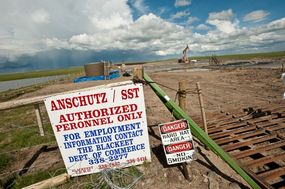 |
My primary goal by placing my images online and into an interactive map of the Blackfeet oil drilling was to educate and my secondary goal was to build a visual record that can be used by my children or theirs so they understand better the landscape history.
In order to restore a place, you have to know what it use to look like, photographs coupled with GPS locations and flight paths will be in valuable in the future.
I hope that by showing people the photographs they can better see for themselves what is taking place in a part of the world where the things that happen here, only happen HERE.
4. Is there opposition to the drilling in the community? Who is the opposition? Who are the proponents?
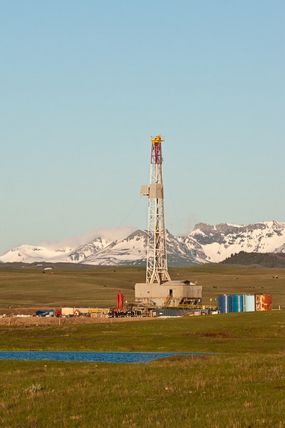 |
I believe there is opposition. It ranges from the little old lady who has to see her backyard demolished, to hunters and anglers who don’t want to see the habitat destroyed and water polluted, to some business owners that rely on a healthy, clean environment for their lively hood.
I also know there are proponents, they are some land owners and most business’s.
In fact, I think people think, “It’s our turn to have the boom.”
Few people look very far down the road at what the consequences might be when this boom turns to bust.
I feel for everyone on all sides, we have to have oil, we have to feed our kids, we need jobs, and we all want a healthy environment.
What challenges me is why in a place where there is so much to offer the people of the world, both spiritually and financially, over the long run, would we chance destroying it for the short-term interests of the global demand for oil? We have a place here that will sustain us for a very long time if we choose to look at it over the long-term.
There will be both losers and winners. I want to find and photograph them all.
5. Do you think there is any way for the drilling to be stopped? How much time do we have left to get the word out and prevent the spoiling of this landscape?
First, I have no false expectations; I’m documenting what is happening. If my images change people’s minds or alert them or open their eyes, that’s good. If it causes them to take action, then that’s good, too.
The development of oil is relentless and dirty – literally.
My hope is that from what I create, others will use for the good of the cause, whatever that might be. I don’t have a law degree but am very knowledgeable about environmental policy, federal Indian policy, and natural resource management and after 20 years of exploring issues from all angles, and places, I believe the best place for me is behind a camera.
How much time is left? Not sure how to answer that.
Listen, think of the earth as an aircraft hurling though time and space. As we dismantle our mother ship by removing it’s pieces, a few rivets at a time, the plane will continue to fly, but for how long? When we remove rivets, we are tinkering with things that we don’t really completely understand, the results of which could be catastrophic. There is no other earth, there is no other place for us to go, we’ve conquered it already.
To finish with the aircraft analogy, think of the rivets on the airplane as pieces of the earths system. If we are on the air craft each day removing rivets one or two at a time, the plane manages to stay aloft because we don’t really need all those rivets.
The down side is we don’t know which are the most important, and we don’t exactly now when to stop taking them out. What we do know is that there are limits to tinkering with the craft, this also applies, in my view, to the earth.
So, if you ask me how much time do we have, I’d say I don’t know but i also don’t want to fine out, because when we do, it will be to late . . .
6. And a bonus question: What’s your favorite hike in Glacier?
Anyplace up the Many Glacier Valley.
Thank you, Tony! If you have questions or thoughts for Tony, please add them below!




My thought today is… this makes me crazy. I have lived on some of the most impovershed places on the reservation.. old low rent..new low rent, but I was born and raised on one of the most beautiful places I know of.
I was raised near the mountain front, a little west of Browning, in a small two bedroom home, with my parents and 16 brothers and sisters. We never relied on monitary value.
Our values came from the earth and respecting the earth.
I was taught at a young age to have the deepest respectful devotion to the land and it will do the same for me. In my 60 years it has done just that.
It is hard being an Earth person, because we tend to keep to ourselves, we know how to survive with out causing a stir. When it comes to confrontation, we have to dig deep within our silent souls to try our best in order to take a stand to protect the Earth.
Spring is on its way. For the past 40 or so years I couldn’t wait to get my hands in the rich black soil to plant something… anything.
I hear the geese and ducks flying and squawking as they decide where they will rest in the wetland beside my home. I look down at the poor pitiful bog where hundreds of native nutritional and medicinal plants grow.
Bog raspberries, service berry, goose berry, choke cherrys along with many willows I use in my healing medicines. I have my secret place where I pick my Sacred Sweet Grass.
There are two plants that grow here that cannot be found anywhere else on the reservation. Even Botanists have told me they don’t grow here, but I know… I found them deep in the middle of the bog close to where the spring bubbles.
In my worst nightmares I never thought it would be this way.
Today I no longer look at things the way I once did, because the oil well that is being drilled just a ways up the road sets between two pure mountain water streams which flow on down to create wetlands… where neighborly water wells lie.
We are now at the mercy of Phillip Anchutz Oil company and the people we chose as our tribal leaders to keep our homeland safe. — And I will add, I have found not one of these people have concerns other then the monetary value they get from the Earth.
Soon the fracking will start, chemicals and other poisons will be flushed into our Earth Mother to extract oil. Before long these chemicals will seep upward through places that once held our pure pristine natural waters, native plants and other life.
This destruction will change the life of the Blackfeet Indian like nothing else has ever done. This makes me sad.