Wild, romantic, and noble, Montana Fish and Wildlife is representative of America.
It’s the America that inspired Lewis and Clark to continue their westward trek, the America filmmakers like John Ford recreated in his Westerns, and the America the US National Parks system preserves.
While in Glacier National Park, viewing Montana’s, fish and wildlife is a top priority on most people’s vacation to-do list. And who could blame them? Outside of Alaska, Glacier is the only place in America that you’re guaranteed to view mountain goats, bighorn sheep, eagles, and bears.
Why is Montana’s fish and wildlife in Glacier so special?
- The dizzying heights of mountains and the valleys that lick their base provide habitat for more than 70 species of mammals and 260 species of birds.
- Over 1,500 miles of rivers and streams and 700 mountain lakes and other wetland habitats home some of the world’s most specialized amphibians.
- It’s one of the last remaining habitats of Grizzly Bears and wolves in the continental 48.
Some of the world’s most endangered animals and other species are found within the diverse range of Montana’s fish and wildlife. And this is part of what makes a trip to Glacier National Park so special: you have the opportunity to see these rare and wonderful creatures.
Plus, it’s a give and take relationship as your park fee is helping in the conservation of this wildlife.
Wildlife Viewing Opportunities in Montana
No matter where you adventure in Glacier National Park, you’re guaranteed to see a wide assortment of wildlife. Certain areas are best for viewing certain animals though:
 |
- Taking your time while driving Going To The Sun Road nearly assures that you’ll see a black bear
- Camping on Bowman Lake and you may hear wolves howl
- Hike near Many Glacier Lodge and you might see Grizzly Bears
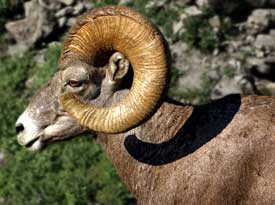
- Spend an hour at Logan Pass and you’ll be guaranteed to see Mountain Goats and Bighorn Sheep
Wildlife Fact File
Want to discover more about Glacier National Park, Montana fish and wildlife? Soon, an entire page will exist on all the parks most popular animals.
For now, here’s a quick wildlife fact file on Montana fish and wildlife:
Mountain Goat
Residing on both the precipices of steep cliffs in Glacier’s backcountry and the bridges in Logan Pass, Mountain Goats are the symbol of Glacier National Park and one of the most commonly viewed large mammals.
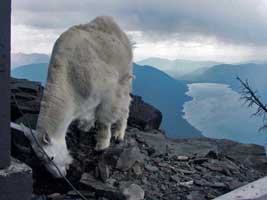 |
Easily the most photogenic of wildlife, Mountain Goats will often pose for humans, which they have become accustomed to.
Grizzly bear
The Grizzly Bears of Glacier National Park typically weigh around 600 pounds and are one of the world’s most powerful creatures. Grizzlies are typically golden and brown in color and are distinguishable from their black bear brothers by a large hump behind their head.
Remember, Glacier National Park is their home. As such, you need to know the proper precautions for hiking in grizzly bear habitat.
Interesting Fact: Their territory used to range down to Mexico.
Moose
Believe it or not, Moose are by far the most dangerous of all Montana fish and wildlife.
These goofy creatures are highly territorial and aggressive. Keep your distance.
If you encounter a moose, you must know how to survive a moose attack
Wolves
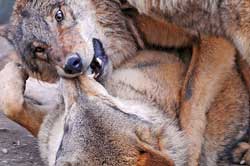
The re-introduction of endangered Wolves to Glacier National Park is one of the park’s crowning achievements in terms of wildlife conservation.
Exploring in Polebridge Montana is your best bet for spotting a wolf pack.
 |
|
Fighting Wolves |
Learn more Wolf Facts & What Do Wolves Eat
Bald Eagle
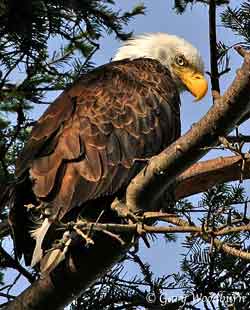
America’s national bird makes its home in Montana’s. Bring a pair of binoculars to the shores of Bowman Lake for viewing this noble creature.
 |
|
A Montana Bald Eagle |
Mountain Lion
Mountain Lions are the most elusive of all Montana’s fish and wildlife. Additionally, it’s probably the last animal you want to encounter. Unlike Grizzlies, Mountain Lions are predatory toward humans, but will only attack in instances it knows it can win.
This is why you should never hike alone and always keep your children close or in a Kelty Child Carrier.
Learn more about mountain lion behavior.
More Montana Fish & Wildlife Information
Wolf Facts – Everything about wolves. Wolf Facts include: habitat, puppies, height & lifespan
Wolf Diet – Interested in What Wolves Eat?
Mountain Lion Information – Everything about mountain lions. Mountain Lion Facts include: habitat, range, what mountain lions eat and attack statistics
Mountain Lion Behavior – Glacier National Park is mountain lion habitat. While attacks are rare, you must be prepared. Learn what constitutes aggressive Mountain Lion Behavior and protect your family in the event of an encounter
Moose Attack – While they may appear docile, moose can be dangerous animals. Learn how to prevent and survive a wild moose attack
Bald Eagle Facts – Everything about bald eagles. Bald Eagle Facts include: what do bald eagles eat, habitat, population, and nest design
Montana State Bird – The Western Meadowlark is the Montana State Bird. Learn all about it, including identification tips, mating habits and habitat
Montana State Flower The Bitterroot is the Montana State Flower. Learn how it was named, its history and identification tips
Return home from
Montana Fish and Wildlife




Perry…I very much enjoy your articles and have read several. Just want you to know how disappointed I am to hear that our wolves have lost the protective support of the wildlife management organizations. My heart breaks hearing news of so many wolves being killed in Montana. They were reintroduced as an
endangered species and now we’re making it so simple to kill them. I don’t understand. Since your articles focus on Montana tourism…please pass my disappointment on to your sponsors. I am devastated at the thought of so many of our wolves losing their lives.