Finding the best hiking boots to use on trails in Glacier National Park is a difficult process. But please, don’t discount the necessity of one: if you fail to invest your money in a good day-pack, hiking pants/shirts, or a hydration backpack, hopefully it’s because you bought yourself a solid hiking boot.
A true hiker can point out the tourists who will be limping home because of a twisted ankle or blisters. It’s easy: they’re the ones wearing sandals, flip-flops, crocs, Birkenstocks etc. And they’re the ones who will have an entire trip ruined because of ignorance, the desire to be stylish, or whatever other foolish reason they’ve contrived.
How to Buy the Best Hiking Boots For Your Needs
Hiking is not about being stylish on the trails: it’s about enjoying nature in a safe and secure manner.
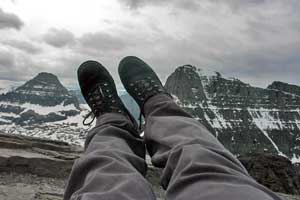 |
Even on the most leisurely of trails such as Avalanche Lake, this is not a stroll through your suburban neighborhood.
There are rocks to climb over, scree to slip on, snow to trudge through, and fallen trees to pass.
Although these conditions don’t require one of the best hiking boots on the market , you still need:
- A boot with good traction,
- that provides ankle support,
- is water proof with gore-tex material
- and well broken in to prevent blisters.
Why Can’t I Just Hike in my Tennis Shoes?
They have good traction; my feet are comfortable and breathe easily. Why should I plop down a few hundred of my hard-earned dollars for a pair of heavy boots?
Traction
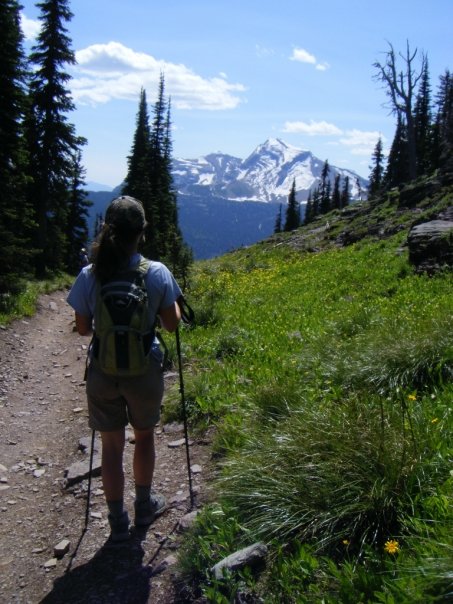 |
First off, tennis and running shoes are designed for running around a court or on concrete. The material on the base of their shoes provides traction on these materials–not dirt, rocks or bark.
As a result, you can easily slip while hiking on a trail and on some precarious trails such as the High Line Trail or Ptarmigan Tunnel, a slip’s life threatening.
Ankle Support
Also, how high do these shoes go? Your ankle, right? The best hiking boots go higher, so when you ‘roll’ your ankle going downhill or on a large rock you didn’t notice, your ankle’s supported and won’t fracture or twist.
It certainly is unpleasant to be a few miles into the wilderness and have to limp all the way to the trailhead (not to mention embarrassing!)
Pack Weight
Day hikes in Glacier National Park also require packs to carry food, water, and clothing to adapt to the changing weather. As such, you’re going to carry a pack weighing upwards of twenty pounds.
Think the ankle support from tennis shoes is going to help you out? Not one bit! The best hiking boots are designed to aid your ankles in dealing with extra weight from packs. Combine Glacier National Park hiking trails, a day-pack and tennis shoes, and you have a recipe for ankle rolls.
Gore-tex
The best hiking boots these days come waterproofed straight from the manufacturer. Advancements in technology have created a wonderful material called Gore-tex.
Gore-tex is a breathable material that’s also waterproof and windproof. As a result, your feet stay dry when crossing streams, sweat evaporates easier and blisters are infrequent.
While some backpacking boots are made of pure leather, adding unnecessary weight and forcing you to waterproof them yourself, Gore-tex boots are light and come water proofed. I’d never recommend a pair of hiking boots that aren’t at least partially Gore-tex.
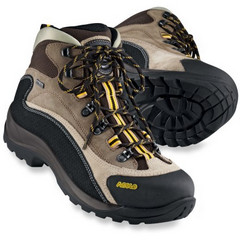 |
In my opinion, Asolo Hiking Boots are the best hiking boots.
When I hiked 500 miles across Spain in one summer, I was the only one in my group of 15 that didn’t get a single blister.
Some even had their boots fall apart on them!
Because of this, I will only recommend Asolo hiking boots.
They are quite simply the best backpacking and hiking boots for women and men. I encourage you to check out my more detailed review of Asolo hiking boots for a picture clear idea of why I’m so passionate about them (and why I think you will be, too!)
My Video Review
I’ve started to interview people while hiking about their outdoor gear and filming it as video testimonials. Below is my personal testimonial on the Asolo boots I use so you can see first hand why I love them so much:
If you’re interested in more Asolo boot reviews, here is our current library:
Determining the Best Hiking Boots For You
Purchasing hiking boots a daunting task. With so many options, how do you find the best hiking boots for you?
Some are heavy and clunky but provide better ankle support. Others are lightweight, breathable but there’s little ankle support.
Here are some things to keep in mind while shopping for a hiking boot:
The Hiking Shoe
The hiking shoe is a shoe with materials on its base meant to provide good traction on hiking trails. They also have very breathable material for your feet, allowing for adequate ventilation.
However, keep in mind that this is a shoe masquerading as a boot. They provide NO ankle support.
And ankle support is the most important factor when purchasing a hiking boot. Poor ankle support is how injuries such as twisted ankles and broken legs occur.
Also, notice that mesh material that allows your feet to breathe? It also allows your feet to become damp and soggy, as this is not Gore-tex.
Bottom-line: Hiking shoes provide no ankle support nor are they waterproof. Avoid them like the plague.
Socks
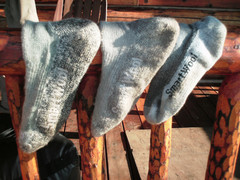 |
Hiking boots are designed for pairing with wool socks. So when shopping for your boot, bring or purchase a pair of wool socks to test your hiking boots out with.
Cotton socks are thinner than wool are, so the boot might feel perfectly snug with cotton socks but tight and uncomfortable when wearing your wool, hiking socks.
Why can’t I wear cotton, you ask? First off, the slogan when hiking is that ‘cotton kills’. And although you won’t die from wearing a pair of cotton socks, the benefit of wool socks are priceless:
- Quick drying, thus helping to prevent blisters
- The material’s more breatheable
- Wool hiking socks are cushions for your feet. After ten miles on the trail, having every step slightly more cushioned adds up.
Test Walk Your Boots
There’s nothing wrong with taking five minutes to walk around the store or block with your boots. After all, you’ll be walking miles in them so don’t be shy or embarrassed to stretch, stomp, trudge and kick in these potential new boots.
And don’t try walking on level ground as Glacier National Park is in Montana, which is Spanish for Mountain. Walk up stairs, down an incline, up a hill. All the while, consider the following:
- Are your toes bashing the front of your boot?
- Is any part of your foot rubbing the boot?
- Do you notice a slight burning sensation anywhere on your foot?
- Is your foot tight, snug and secure? Your foot should not be moving in the slightest
If any of the above is occurring, these are not the best hiking boots for you.
Also, don’t let a store clerk rush you; investing in a pair of hiking boots is a major commitment as they’ll be with you for years.
Honestly, I bought my last pair of boots online and it’s for just that reason: I hated being rushed and hurried out of a store. I know my size and the brand I like, so I read some reviews and went online to buy my boot. And unlike stores like REI, pretty much all online stores will allow you to return your boot at any time, no questions asked, so long as the boot doesn’t look too beat up.
Waterproof
I like Gore-tex. It’s lighter than leather and requires no effort on your part to waterproof. However, if you don’t want to plop down the extra money for this material, make sure your boot is leather so you can waterproof it.
While hiking in Glacier National Park, you’ll be trudging through mud, splashing in puddles and might get caught in some rain. Wet boots lead to wet feet, which leads to blisters and a miserable vacation.
Comfort
Don’t forget this aspect! Most importantly, the best hiking boots are ones that are comfortable. If your feet aren’t happy, you won’t be happy.
Your boots should melt into the background, busily working at giving you the best hiking experience you can possibly have. If you’re wearing the right boots for hiking, then you’ll be focused on the sight, sounds, and smells of your expedition, not on what you’re wearing on your feet.
In my opinion, the best boot for hiking are those made by a single company: Asolo.
I had the pleasure of wearing a pair of Asolo hiking boots on a long trek across Spain. Everyone else in my group got blisters so big they’d make you cry to look at them–but not me. I was the one with the Asolo boots–the only one–and I came out the other side of the expedition feeling absolutely fantastic.
Ever since then, I’ve worn and recommended nothing but Asolo hiking boots, and they’ve continued to impress me with their comfort, design, support, protection, and style. It’s for that reason that I view them as some of the best boots for hiking.
What Makes a Good Hiking Boot?
Before we dive into my picks for the best hiking boots for men and women on the shelves today, let’s chat a bit about what makes a good hiking boot… well, good! These are things you really need to keep your eyes open for when searching for a new pair of hiking boots–especially if you decide to get some boots that aren’t made by Asolo.
|
- Support — There may be nothing more important than ankle support in a pair of hiking boots. Going uphill, downhill, or side to side, your ankles are especially vulnerable. You need to make sure you are doing all you can to avoid a twist, sprain, or even a break. Wearing good hiking boots with plenty of support will go a long way towards making sure you stay healthy and active.
- Comfort — Why buy a pair of boots if they aren’t comfortable on your feet? Different people have different foot shapes–even those who wear the same sizes of shoes. So take the time to try on as many pairs of hiking boots as you can to find the models that provide the most overall comfort.
- Protection — I’m talking about more than just ankle support when I talk about protection. Who knows what condition the terrain will be in when you go hiking or what Mother Nature has in store for that particular morning or afternoon? Nobody does. That’s why the best boots for hiking are protective boots made with a waterproof design, tough materials, good and hardy soles, and anything else that will keep your feet warm, dry, and safe.
- Durability — The best boots for hiking are expensive. So when you buy a pair, they should be ones that will last you a good while. No matter if you hike everyday or every other month, your boots should be as durable as possible. This will not only increase their lifespan but also provide you more protection with their resilient construction.
Are there any other factors to take into consideration when buying the best boots for hiking? Of course there are, but these are probably the most important. Nail them down and you’ll be on your way to finding the perfect pair of trekking kicks.
Who Makes the Best Hiking Boots?
I’ve already given you a little bit of insight into why I think Asolo is hands down the best brand of hiking boot out there today. But my reasoning for that goes way beyond that one experience in Spain.
 |
Asolo is a company that has been around the block a few times–they know what it takes to create the perfect hiking boot: high quality materials, high attention to detail, and high technology.
Asolo is a company that doesn’t know how to rest on its laurels. They are always striving to invent more, innovate farther, and push the industry’s envelope in terms of protection, support, and comfort.
They have a few technologies of their own that are definitely worth mentioning:
Fit
This is about more than comfort–this is about shape. Asolo has always strived to make hiking boots and shoes that look great, but they also have a great interest in making them fit perfectly well. Asolo has taken the time to understand the human anatomy. They have learned about the intricacies of forefoot, instep, heel shape and height to make sure that their boots and shoes have the best fit of any product out there. This is true of both men’s and women’s models, which is pretty impressive considering they have very different geometries and physiologies.
Triple Power Structure
Two of my top picks in the Asolo lineup feature the Triple Power Structure, or TPS. This is a multi-layered sole that has three shock-absorbers to keep your feet from being negatively affected by the impact of each step you take. The three absorbers are: High Density PU Midsole, Low Density PU Element, and Asolo/Vibram Rubber Outsole.
Carbon Kevlar Asoframe
An Asoframe attaches the toe to the heel, making it one continuous sole chassis. Using two separate materials, Carbon and Kevlar, this structure helps to maximize comfort, balance, and light weight construction.
Tri Fusion Technology
You can find the Tri Fusion Technology on those Asolo models that feature automatic crampons. Asolo, in conjuction with Vibram, created this technology to maximize support and balance. The TFT has four basic components, including: Active Crampon Adaptor, Active Skeleton, Rubber Insert, and Rubber Bottom. Currently there are no less than nine models in the Asolo lineup that feature Tri Fusion Technology in their designs.
The Best Asolo Hiking Boots for Men and Women
Below, I’ve listed my top three choices for the best men’s and women’s hiking boots on the shelves today.
If you’d like to learn more about these six boot styles, click on my links for Men’s Hiking Boots and Women’s Hiking Boots. In those articles, I go into much greater detail about why I think that these are the best boots out there for hiking.
|
More Hiking Boot Info
Keep Your Feet Dry: Having waterproof hiking boots is vital in Glacier National Park. Learn how to waterproof your hiking boots and the best hiking boots that are already waterproofed.
Hiking Sandals: Although I wouldn’t recommend purchasing a sports sandal for hiking trails with, they are great for lounging around the campsite in. Learn about purchasing the best hiking sandal.
Smartwool Socks: Learn why Smartwool Socks are the world’s most comfortable sock and the best merino wool hiking sock
Asolo Hiking Boots – I love my Asolo hiking boots. Come learn why I’ve hiked over 3,000 miles only in my Asolo GTX hiking boot, one of the best waterproof boots for hiking
Men & Women Hiking Boots: Read my recommendations on the best men hiking boots and best women hiking boots.
Men & Women Hiking Shoes: Read my recommendations on the best mens hiking shoes and best womens hiking shoes.
Hiking Shoes: Although I don’t recommend them as they lack ankle support, hiking shoes are satisfactory for using in basic trails. Learn about the best hiking shoes on the market.
Hiking Boot Laces: It can be incredibly frustrating to keep retying your laces while hiking. Luckily, there are hiking boot laces that are incredibly durable and rarely come untied.
Discount Hiking Boots: Learn the secrets of finding discount hiking boots and shoes.
Ready to return
home from determining the best hiking boots for you?




Hey, would you recommend gortex boots for those who live and hike in the dessert? Is it too hot?
Hey, would you recommend gortex boots to those who live and hike in the desert? Is it too hot?
It depends on the exact shoe, but most GoreTex shoes these days are designed to be every bit as breathable as they are impenetrable to outside forces. One of our favorites this year can be found here: http://www.backcountry.com/zamberlan-airound-gtx-rr-hiking-shoe-mens
Wow, sorry I submitted that same question three times. It wasn’t working at first…
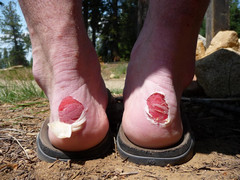
I have read the article and find it amazing that I have heels that look nearly identical to that poor sole pictured above. How did I get them. Wearing a pair of Asolo hiking boots from REI which I wore 20 times around the house and working with no problem for hours at a time. Then in ten minutes on my first hill my heels were torn to bits. I didn’t have enough time to get sweaty, my socks were dry, I had a thin sock under a smartwool sock and my heal was as locked in as it could get. I have not found any true hiking boot that do not tear me to bits. I spent 3 years trying to break in a pair of $300 Scarpa, all leather hiking boots for a 50 mile hike with the scouts. Never got them to work for me. a waste of money. I have had this problem now for 25 years and simply put its the cheap boots that don’t fit snug, and don’t require multiple layers of socks, that work for me. the problem is that cheap boots are not usually water proof. They are flexible and able to mold to my foot shape. Im not mongrel but I have a wide foot and a much wider heel than most. I wish somebody would make a high quality boot that is not stiff as all hell and had more than one crappy width to choose from. Nobody makes widths other than Newbalance. Their 1569 boots by the way are the only ones I have found that don’t blister me. And they work right out of the box. I know because I did it last year on hunting trip. Not a single blister. The sole sucks in snow but I am on my way to have a better sole put on a pair to see if it works. Good luck readers.